

If you want to rock the piano like a pro, mastering your chords is non-negotiable. Rock piano chords aren’t just a skill—they’re your secret weapon. With them, you can learn songs faster, transpose into any key, write your own music, and make the same chord sound fresh in different ways.
Here are 3 essential tips to get your rock piano chops screaming in all 12 keys. And don’t forget—our full video lesson on rock piano chords will take you even further!
Music and math? Believe it or not, there’s a formula to make your chords bulletproof. Triads—major and minor—are the bread-and-butter of rock piano chords, and learning to build them in any key is a game-changer.
Here’s the shortcut:
Once you can do this in all 12 keys, you’ll have the core toolkit every rock pianist dreams of.
💡 Pro tip: Think in scale degrees: root (1), 3rd, and 5th. That’s your chord DNA.
In order to build a major triad, we need to find the first 5 notes of a major scale. Below are the first 5 notes of a C major scale.
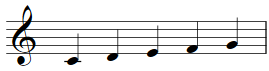
Now let’s look at the “formula” for building the first 5 notes of a major scale. We call these notes scale degrees. The 1st scale degree is also called the root. In order to move from the root to the 2nd scale degree (C to D) we move up a whole-step. From the 2nd to 3rd, another whole-step. From the 3rd to 4th, a half-step. And from the 4th to 5th, a whole-step.
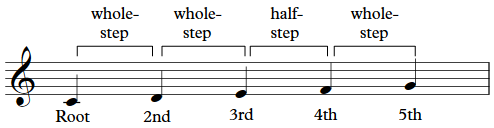
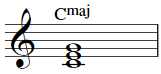
In order to build a major triad, simply play the root, 3rd, and 5th all at the same time.
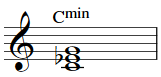
And in order to turn this major triad into a minor triad, simply lower the 3rd degree a half-step.
Here’s where things get really fun. Your triads don’t have to sit in one position. Switch things up:
These inversions make your chords more flexible, dynamic, and full of life. Suddenly, your playing sounds more professional and exciting!

Want your chords to fill the room? Add a 4th note by doubling your lowest note an octave higher.
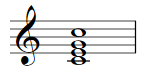
For example, a C major triad (C-E-G) becomes C-E-G-C (octave up) and BOOM!—your chord sounds thicker, richer, and pure rock energy.
Do this with all your chords and watch your piano playing explode with power and presence.
A focused 6-week deep dive into the feel, technique, and soul of rock piano — using Elton John's "Guess That's Why They Call It the Blues" as your complete performance vehicle.
🎹 Check out the full program and reserve your spot today:
👉 Rock Piano Intensive Details
Don’t just play the piano—make it rock! ⚡
