Not showing me what to practice, but how to practice.
Bruce W. · South Carolina · Premier
Teaching piano online since 2000
Right now our members are learning blues
Anyone can learn a song by rote. We teach you to understand what you are playing — to improvise, build your own arrangements, and hold your own with other musicians. Five focused minutes at a time.
Try one right now
Not previews and not sample lessons — four complete practice actions, exactly as a member gets them. Two for someone starting out and two for a player already well down the road, in blues and in jazz. Press play, learn the one thing, then go and do it. No signup, no card, no email.
A practice action is complete on its own: one idea, played and explained, with the exercise on screen. You are not being warmed up for the real lesson — this is the thing itself, and at the end of it you know what to go and play.
This is the part a five-minute video on its own can never do. A video on YouTube ends when it ends, and you are back to searching. Inside the Academy every practice action sits on top of the full lesson it came from — every chapter, the sheet music, the backing track — so the moment you want more, it is one click down, not another search.
Six practice actions completes a path and earns a certificate. There are 108 of them across 18 curated paths, in order, so you are never deciding what to practice — you are just doing the next one.
The Academy is built around the twenty minutes you actually have at the piano, not around another library to get lost in.
Your path hands you the next practice action — five to ten minutes, one clear job. You do not need another hour-long lesson right now. You need to know what to do at the piano tonight.
Six practice actions completes a track, and you earn a printable certificate and a badge. Most piano platforms are infinite. This one has ends you can reach.
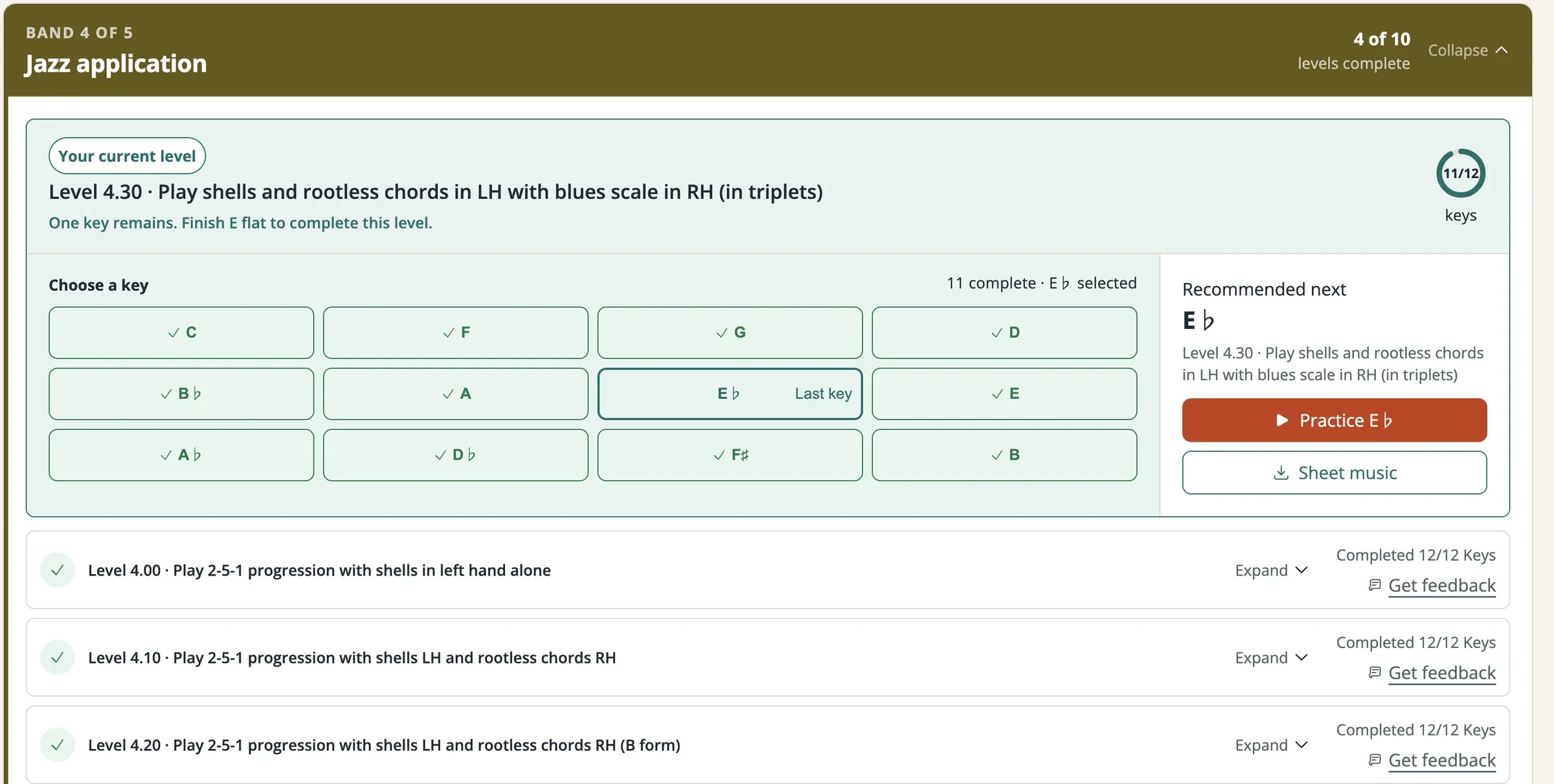
The Jazzedge Practice Curriculum runs 41 levels across 12 keys — 492 individual targets, each one tracked on its own, in a deliberate order rather than alphabetically down the keyboard.
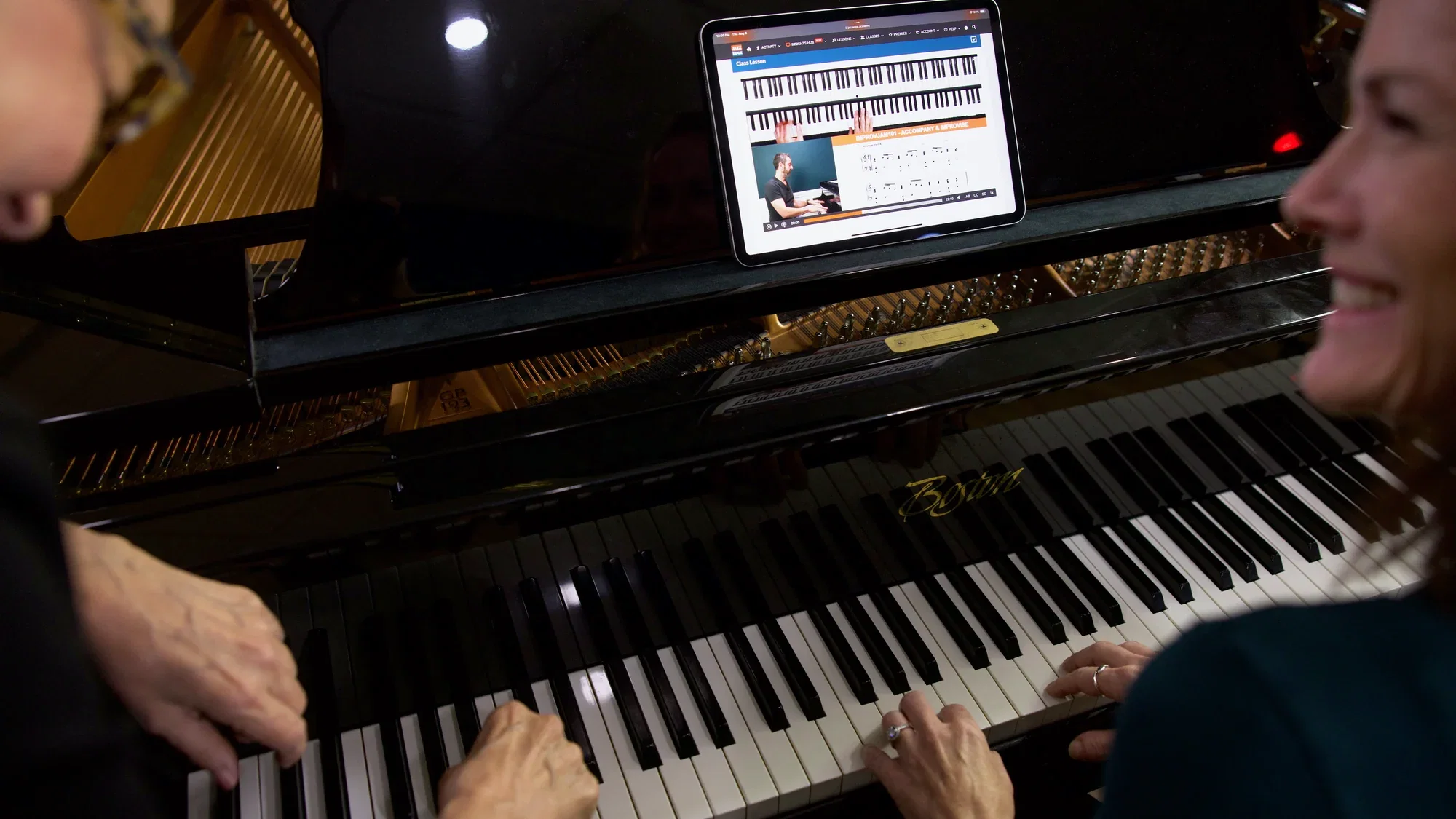
The Jazzedge Practice Curriculum is the part nobody else has. Most platforms hand you a scales lesson and call technique covered. This one tracks every key of every level on its own, so you can see exactly what you have and have not played.
Every level is practiced in all 12 keys and tracked one key at a time. 41 levels across five bands — 492 individual targets, not a checkbox on a scales lesson.
The order is deliberate — C, F, G, D, B♭, A, E♭, E, A♭, D♭, F♯, B. Not up the keyboard, and not the circle of fifths: it is the order Willie arrived at from teaching it, because it is what works with students. You never have to decide what to practice.
Finish a level in all twelve keys and you can send it in to be graded, with written feedback — at every membership level, not just the top one. Not a forum reply: the teacher, on your playing.
Not a scales page and not a practice suggestion — a named target, in one key, demonstrated end to end. Four and a half minutes, then you go and play it in that key until it is yours.
What you open every day
Lessons are the easy part. Coming back on a Tuesday in February is the hard part, and that is what this screen is built for.
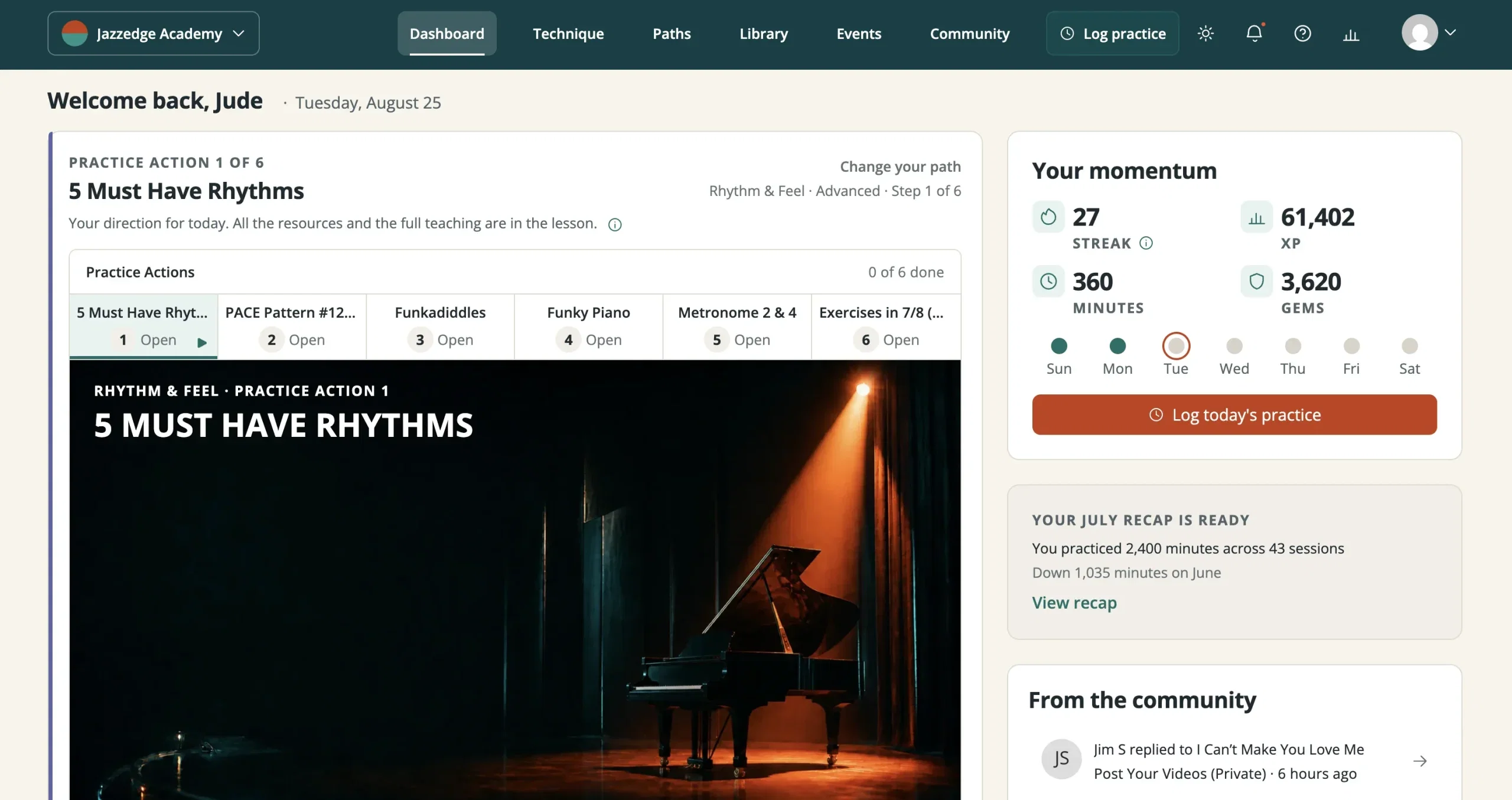
Not a catalogue and not a feed — the practice action you are on, with the path and the step it belongs to. The decision about what to work on tonight is already made.
Minutes, a running streak and the week laid out day by day. One button logs today. It is not a scoreboard — it is evidence, and on the days you feel like you are getting nowhere it is the thing that says otherwise.
Every month you get a recap: minutes, sessions, and how it measures against the month before — including when that is down. A practice record that only ever flatters you is not a record.
Community replies and the live event calendar sit on the same screen as your practice. Playing alone in a room is the main reason adults stop.
You’ve created a very user-centric portal that is wonderful to use. I feel that I can track and alter my goals as I progress. Fantastic functionality!
Inside a lesson
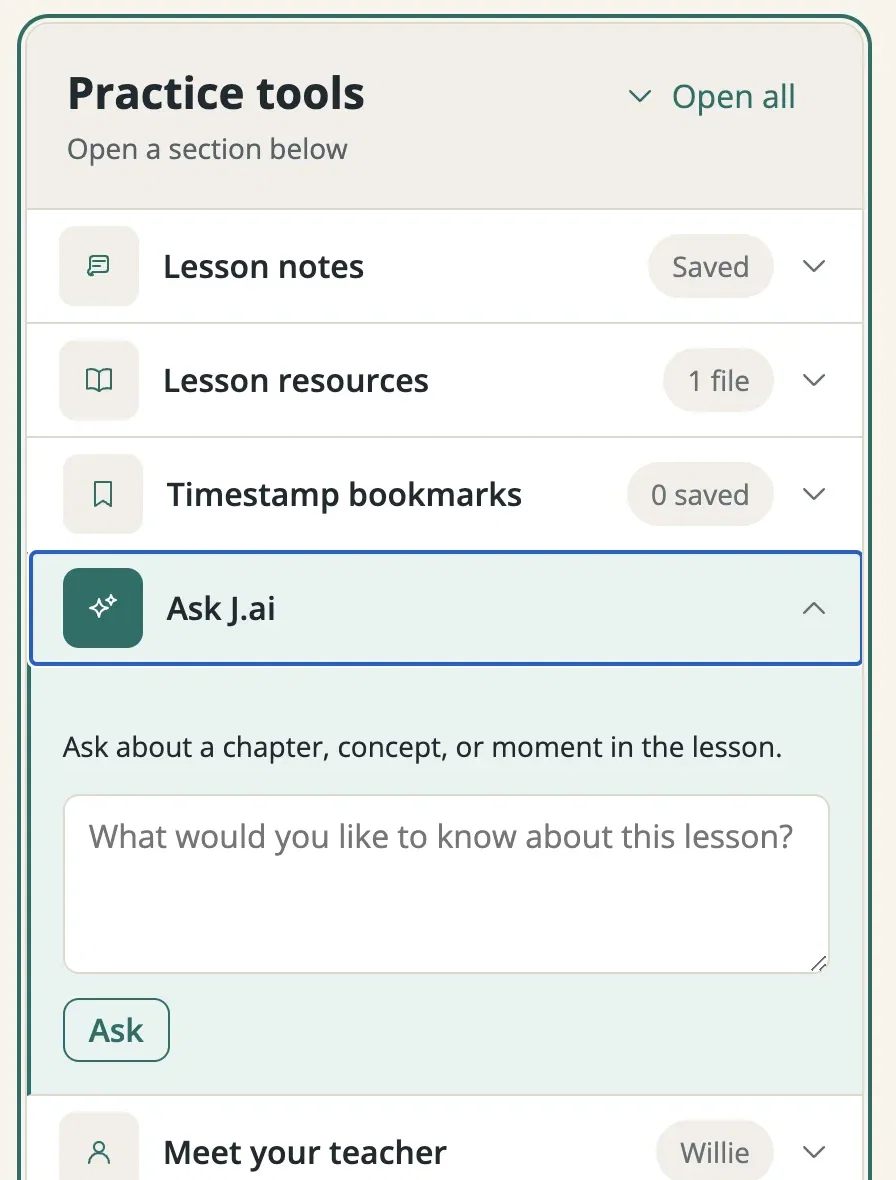
Every lesson opens as a workspace: the video and its chapters on one side, and everything you need to actually practice it on the other.
A question about this chapter, this concept, this moment — answered from the lesson’s own material rather than the internet’s general opinion of piano. Every membership includes a monthly allowance.
Write down what you worked out tonight, and find it here next time. Not in a notebook on the piano that you will lose.
Bookmark the four seconds where the voicing finally makes sense, and come straight back to it tomorrow instead of scrubbing for it.
Resources and downloads sit beside the video, with the teacher who recorded it named underneath. No hunting through a separate downloads page.
The library
Jazz is the biggest single style here and it is nowhere close to all of it. Standards, Motown, rock, gospel, bossa, blues — taught as arrangements you can actually play, not as transcriptions to copy.
Start with the sound you want to work on:
Play and know
Plenty of places will get you through a song. The point of the Academy is what you can do once the sheet music is closed.
Take a blues or a standard and play something that is yours over it — with the scales, licks and voicings to make it sound intentional rather than lucky.
Improvisation path · The Confident Improviser, live every other week
An intro, a way through the form, fills that land where you want them, and an ending that does not just stop. A lead sheet becomes a performance instead of a page.
Harmony & Chords path · song lessons taught arrangement-first
Comp behind a soloist, keep time that other players can lock to, and hear where the music is going before it gets there.
Rhythm & Feel path · Funk & Groove path
The difference between knowing a song and knowing the music. Every level of the curriculum is practiced in all twelve keys and tracked one key at a time.
Jazzedge Practice Curriculum · 492 tracked targets across 41 levels
Thank you so much for the lessons — they are incredible. I’ve never played so well. Last night I went to my first jam session, and people danced to my playing! It’s been life-changing for me.
Premier video reviews
This is the part almost nobody else offers, and the reason people stay. Premier members send video of their playing and get a written response from me — on their playing, not on the topic in general.
Recorded on your phone, at your piano, whenever you are ready. Tell me what you want me to listen for — or just send it and let me tell you.
Not a score out of ten and not a reply from another student in a forum. What is working, what to fix, and the one thing to do next.
Up to three lessons, chosen by me for what I just watched you do. Not an algorithm’s guess at what people like you enjoyed.
Three of them, and they are musical rather than administrative. You always know which one you got and what it means.
It is not there yet, and you deserve to be told so plainly rather than politely.
The eighty percent mark. Close enough that the remaining work is worth naming exactly.
You can play it for someone. It can go straight into your repertoire — a list of pieces you can actually perform, not ones you once studied.
Working on limited sections of the song, along with the video-submission accountability, has pushed me to really have the parts down. In the past, I might have gotten close enough but not really mastered the sections.
2,127+ submissions graded so far. Video reviews are part of Premier.
Not showing me what to practice, but how to practice.
Bruce W. · South Carolina · Premier
Exactly what and how to practice to learn the new song.
Gayle · California · Premier
He records short videos of the tricky parts.
Shari · Premier
Who is teaching you
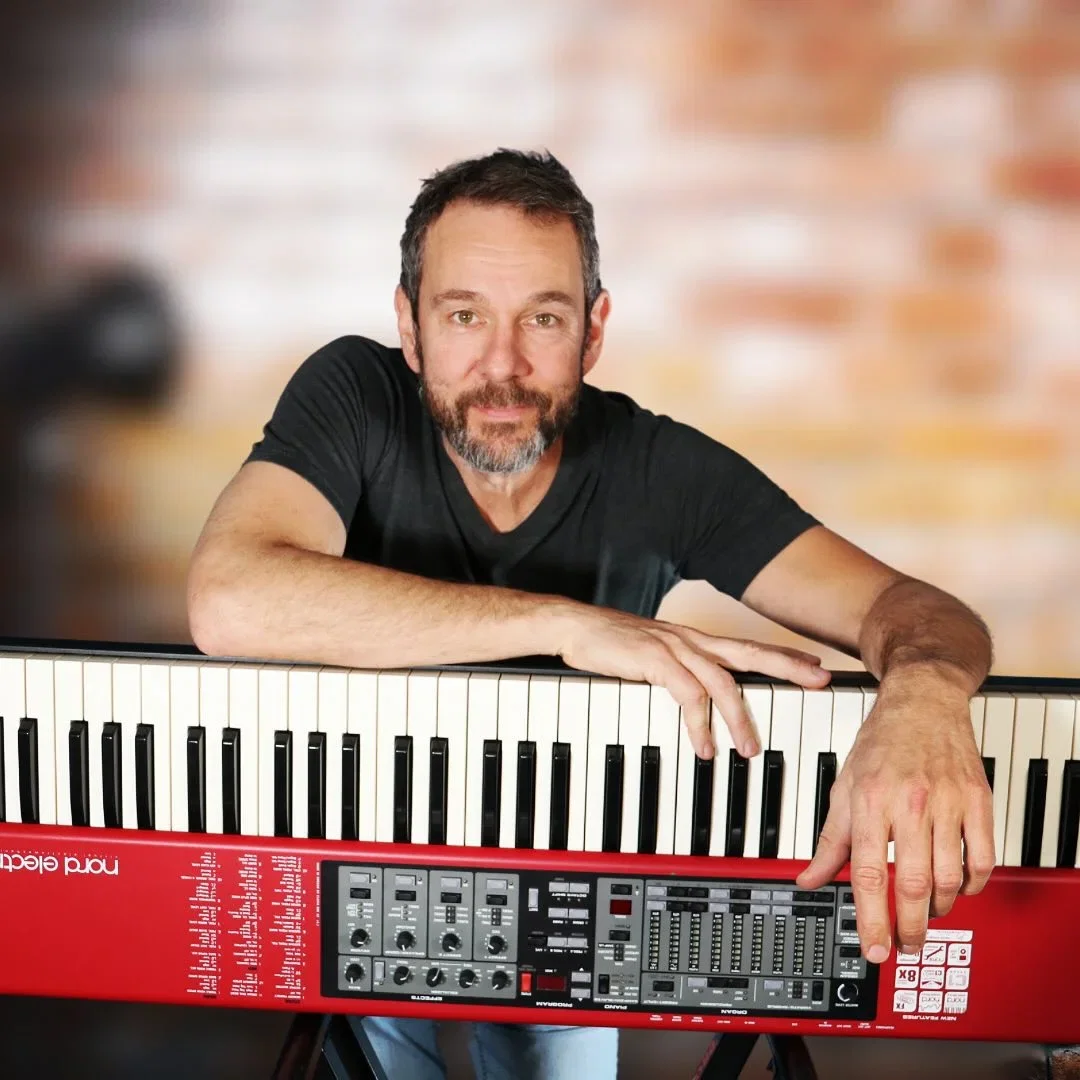
I went to Berklee, and when I came out I started teaching kids — first privately, then through JazzKids, a method I built to teach teachers how to teach improvisation to children. I toured the country running workshops for other piano teachers, showing them how to get their own students improvising. That work became more than a dozen books on jazz.
All the while I was playing. Multiple tours with my group, Katahdin’s Edge, and we headlined South by Southwest. I have never stopped performing, and I do not think you can teach this music honestly if you have.
When the internet arrived in 2000 I started making short videos for my own students — not as a business, just so they would have something to work from between lessons. Then people I had never met started finding them and working through the material on their own. It was working without me in the room.
So I made a decision that seemed reckless at the time. I had a full private studio, and I let it go. I incorporated Jazzedge in 2009 and taught entirely online from then on.
Since 2008 I have coached hundreds of students one to one, and taught many thousands more through the Academy — most of them adults who were told at some point that they had started too late.
That is still the job. The practice actions, the curriculum in twelve keys, the videos you send me to grade — all of it exists because it worked in a room with a student, long before it was a feature on a website.
— Willie Myette, founder
Focus or Premier
Both give you the same path, the same technique curriculum and the same certificates — and every member can send a finished level in to be graded. The difference is one month of your practice, so here is what that month actually looks like.
You stop deciding what to practice.
Choose Focus if the problem you actually have is not knowing what to work on tonight.
You stop guessing whether it is any good.
Choose Premier if you want to be told the truth about how you sound — and pointed at what to do about it.
Your practice record and your progress through the curriculum belong to your account, not to your plan.
Both give you a path to follow and a way to track the work. Premier adds the part almost nobody else offers — a teacher who listens to your playing and tells you what to fix.
Clear direction, without the overwhelm of the full Academy.
$24 per month
$240 per year
Recommended
Deeper instruction, guided practice, and personal feedback.
$59 per month
$590 per year
Not ready to pay? Start free with the 30-Day Playbook — a complete 30-day program, no card required.
30-day money-back guarantee. On your first membership with us, email support@jazzedge.com within 30 days and we will refund it. One refund per customer; renewals and downloads are not refundable. Full terms
Questions
No, and this is built for exactly that. Most members here are adults with jobs, and the whole system is designed around short, focused practice rather than hours a day — five minutes done properly beats an hour of drifting. You are not competing with anyone.
A practice action is about five minutes, and one of them is a complete session. If you have twenty minutes, do a few. If you have an hour, the full lesson sits underneath each one. The point is that a short session still counts and still moves you forward, so a busy week does not undo a good month.
No. Reading is taught along the way and the notation is on screen when it helps, but you are shown what to play and where your hands go. Plenty of members arrive not reading and pick it up as they go.
No. Jazz is where Willie came from, but the library runs to blues, gospel, rock, pop, Latin, cocktail piano and standards, and the technique work underneath is the same whatever you want to play. The practice actions on this page are deliberately two different styles for that reason.
A five-minute video that teaches you one thing and then sends you to the piano to do it — with the complete lesson it came from sitting underneath, for the night you want more. There are 108 of them, arranged into 18 curated paths.
The technique spine: 41 levels, each practiced in all twelve keys and tracked one key at a time — 492 individual targets rather than a checkbox on a scales lesson. Every membership level includes it. Finish a level in all twelve keys and you can send it in to be graded, with written feedback.
Willie does, in writing, on your playing — not a forum reply and not a score out of ten. A finished curriculum level can be sent in for grading at every membership level. Premier adds video reviews: send any playing at any time and get a written response, up to three lessons chosen for what you just did, and a verdict where one fits.
Focus gives you the practice actions, the curriculum and a structured path through it. Premier adds the full lesson library, video reviews of your own playing, PianoLab with Paul, The Confident Improviser, and the community hours and intensives. Current prices are in the plans above, read live so a sale is always accurate.
Two things. The unit of work is a five-minute practice action that replaces the lesson rather than supplementing it, so you always know what to do tonight. And your playing gets looked at by a person — 2,127 submissions graded so far — which is the part that turns watching into playing.
A piano or a keyboard and something to watch on. Weighted keys are nicer and 88 of them are nicer still, but people start on far less and do fine. Everything works on a phone, a tablet or the laptop on the piano.
Yes, from your own account, whenever you like — there is no phone call and no retention script. Membership is month to month unless you choose yearly. Refund terms are in the Terms and Conditions linked in the footer.
The 30-Day Playbook is free and yours to keep — thirty days, one thing to practice each day, no card. The four practice actions on this page are free too, and they are complete, not previews. Start free — the 30-Day Playbook
The 30-Day Playbook is free and yours to keep — one thing to practice each day, and something you can actually play by the weekend. No card, and nothing that quietly turns into a subscription.
Taught by Willie Myette, teaching piano online since 2000.